A new harmonium 1: Springs
I should be clear that I already have a harmonium. It has three octaves, two ranks (voices) and knee-pedals to operate the swells. It’s small, and folds up smaller. If you saw me carrying it you might mistakenly think I was struggling with a very heavy suitcase.
It’s not the same one as this picture, but it’s similar:

(Photo: eBay listing)
I bought it from Ian Stephenson over 10 years ago and it has gradually become my main instrument. These instruments are of a certain vintage, and they weren’t built to sit quietly in the corner. This one had clearly been heard by many. The insides were in very good condition, and Ian had tuned it nicely, but I had to rebuild most of the outer case.
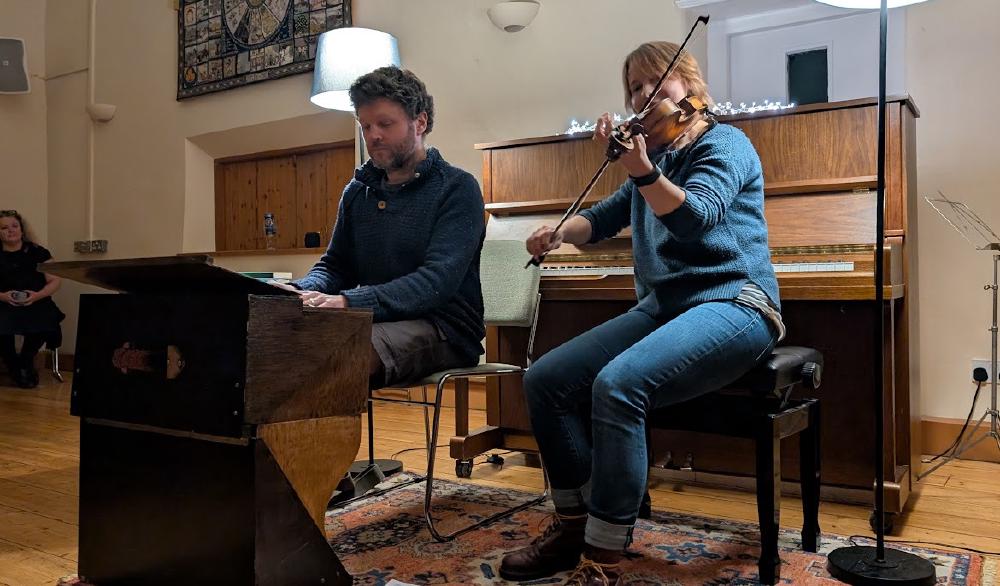
I mostly accompany my wife, who plays the violin very well. We play music from the Swedish and Finnish traditions, where harmoniums play a big part. And 6 times out of 10, after we’ve done so, someone will come up to me and ask “what is that instrument? I’ve never seen one like that before!”.
The answer is “It’s a harmonium. Or more accurately an American pump organ. Or more precisely, a Bilhorn Telescope Organ”. I don’t want to be pedantic, but they did ask. And that is the answer. But most people say “harmonium”.
Loss aversion
I hadn’t seen a real one before either, and I haven’t seen one since. I keep an eye on eBay and they don’t come up often. There are plenty of furniture-size harmoniums, and plenty of one-handed Indian-style ones. But nothing this portable, and nothing that has this sound.
When something obscure becomes your main instrument, the risk of losing it becomes so much greater. If my wife loses her violin that’s a problem, but someone else can make a new one. If I lose my harmonium, I have to make a new one.
After camping trip with Joel Stewart, who makes objects far more intricate, and with no right-angles, I was inspired to start looking for tools and ingredients.
Ingredients
I’ve played various squeezeboxes in the past and have a fair idea of how the business end of a free reed instrument works. But the bellows were a foreign country to me, and so that’s where my quest began.
What sets a pump organ apart from virtually any other instrument is that it works on suction. Most squeezeboxes (accordions, melodeons, concertinas, etc) have two whole sets of reeds for each voice, one facing each direction. The bisonoric ones (melodeons, bad concertinas) play different notes in each direction. The unisonoric ones (accordions, good concertinas) play the same note both ways, but still need pairs of reeds pointing each way. Indian harmoniums work on positive pressure, with the player pumping air into the contraption. Church organs, regals, bagpipes etc likewise.
It’s entirely irrelevant with violins, but neither blowing or sucking one produces a desirable sound.
I had a teacher at school who was genuinely infuritated (in an affable way) by people using the word suction. “There’s no such thing as suction,” he used to insist, “it’s just a difference in air pressure!” I learned a lot from him, so I don’t reject this particular lesson respectfully.
But with a pump organ, call it what you like, but the player is doing everything in their power to remove air from the instrument. The foot pedals pull, rather than push, bellows. And these suck air out of the reservoir, which has a spring inside trying to push it open. Air is then sucked in through the reeds, which means you have to pump. It’s a Sisyphean task.
Inside you are two springs
There are two sets of springs at work here.
The bellows attached to the foot pedals pull, rather than push, the bellows. And these suck air out of the reservoir bellows. The reservoir has a spring inside trying to prize itself open.
Another set is in the pump bellows closing them automatically when the player takes their foot off the pedal, ready for another pump.
Springs are clearly pivotal to pump organs. “Harmonium springs” are usually single ply leaf springs, pre-bent into two arcs, riveted together at one end. Those aren’t easy to find (the closest shop I found was in Hungary). But a spring is a spring, at least in theory, and a torsion spring should also do the job.
And so the first thing I bought for the new harmonium project was piano wire. Which is another name for spring steel wire. Apparently. I got a selection of wire gauges to play with.
Something useful
I am not a natural wood-worker. So if I’m going to make an instrument I need to acquire skills, and fast! Or better still, slowly and carefully!
So I looked for a project to start learning how to work with wood and make springs. The natural target was the catch on the attic door.
The catch failed not long after we moved in to the house. When I replaced it I found evidence of generations of inhabitants and their efforts to keep the attic closed. My replacement failed within a couple of years and I’ve been propping the door closed with a piece of aluminium section ever since.
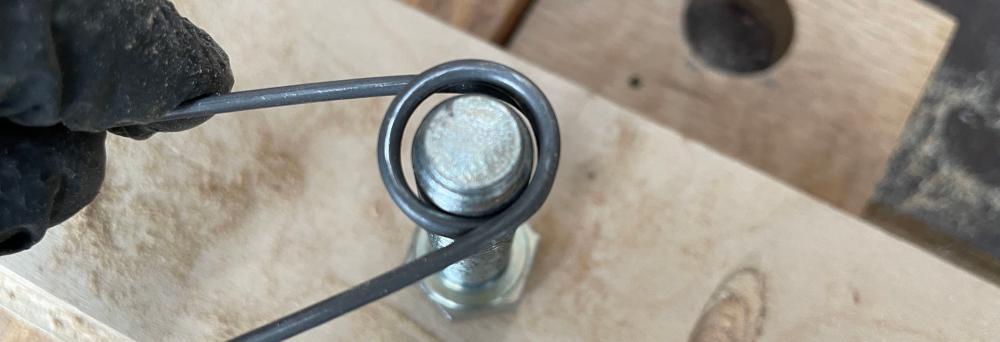
Spring-winding was the biggest mystery. I made a hole to fix one end and slowly bent it round a form. You have to bend it past its yield point and then let it relax, so the diameter and angle of the finished spring will be larger than the form. I put in some pre-load and soon had a coil spring strong enough for a catch that kept the door closed.
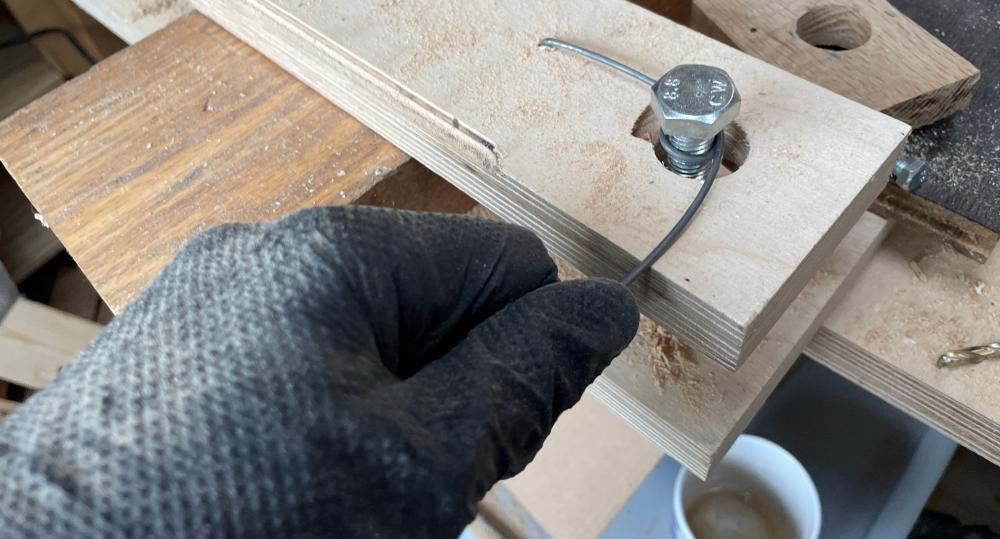
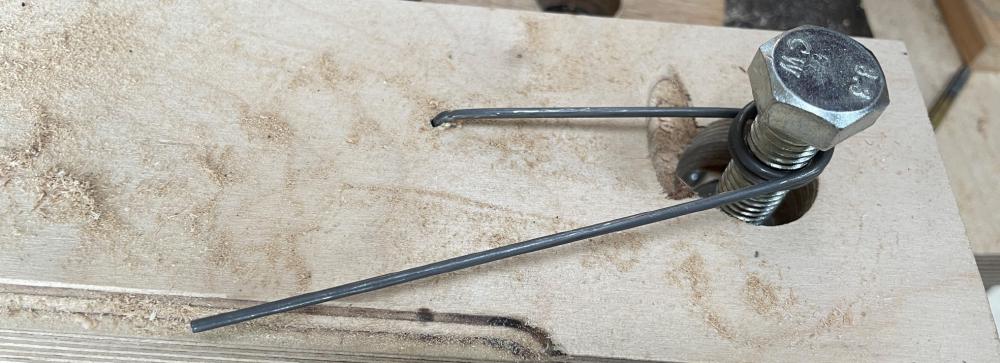
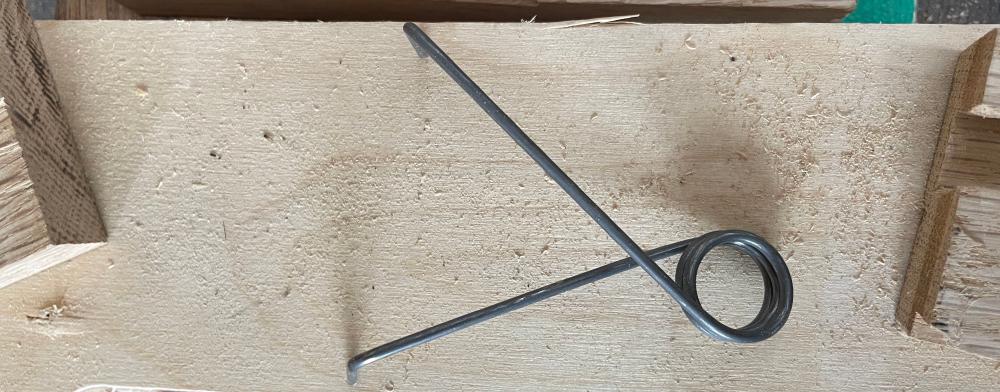
I made a catch out of a piece of oak flooring that a neighbour was foolishly throwing out.
The slider was made using a dovetail bit in the router and some felt to help with the slide and fitting.

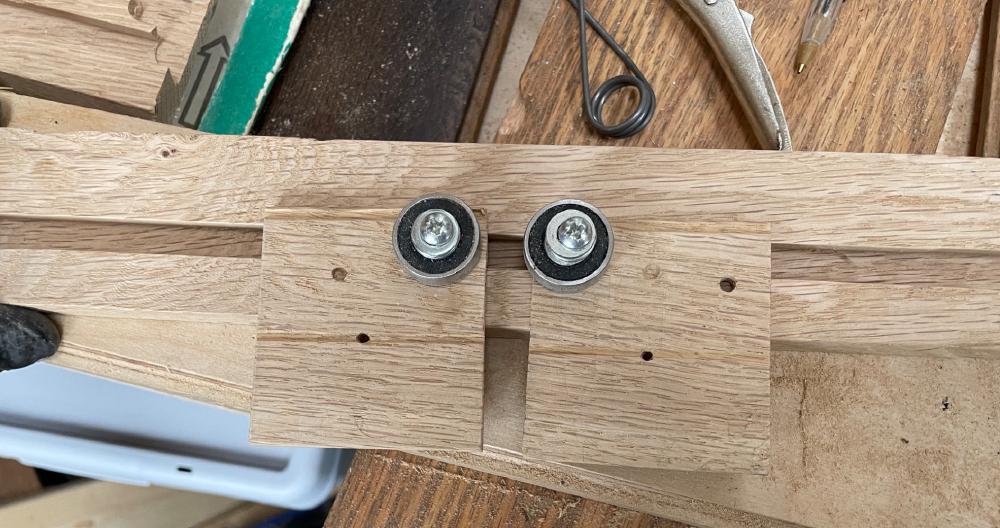
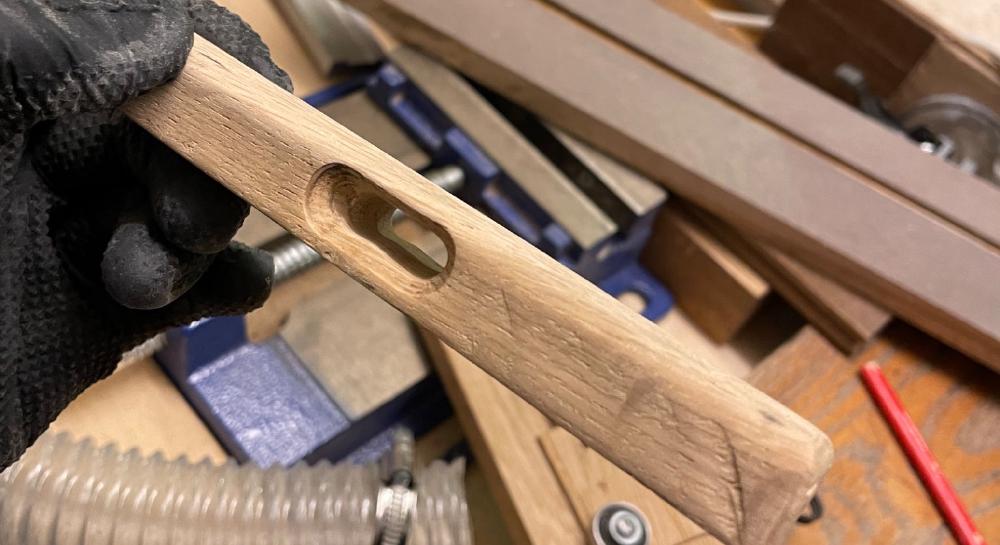
The result was an attic door that would make Stanley Kubrick weep.
You might ask what this has to do with a harmonium. And you’d be right. But I did get practice with the router, and I learned how to make springs for harmoniums. At least, I thought so at the time.
And now the attic door is closed I can start continue making this harmonium…
Lessons Learned
- The ratio between the radius of the form and the ratio of the finished spring depends on the gauge of wire, and probably the radius of the bend. It’s worth experimenting.
- Spring wire isn’t as brittle as I feared, and allows a 90 degree bend with a tiny radius
- Making a small loop is therefore difficult, as the diameter increases when it relaxes. It’s easier to make a square loop with sharp turns than a circular one.