A quick talk, the same content as given at Oxford Geek Nights in November 2012.
Global object appears not to load in Play framework
I was scratching my head for a bit over this one. Using Play Framework v 2.1.0 (Scala) in development mode I was defining my global object as per the Scala Global documentation. But it wasn’t triggering (and, I thought, wasn’t being registered).
OxLork perform at the Ashmolean
OxLork, a band of musicians in possession of computers (and, I hope, an increasing knowledge of how to make new things with them) had a gig at the Ashmolean Museum on Friday. Very exciting.
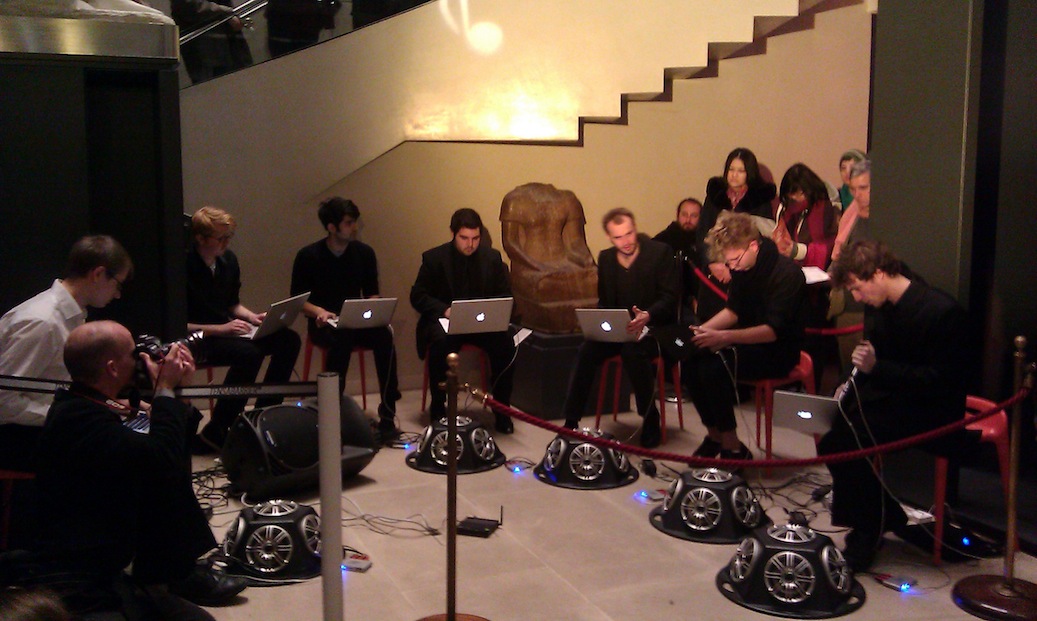
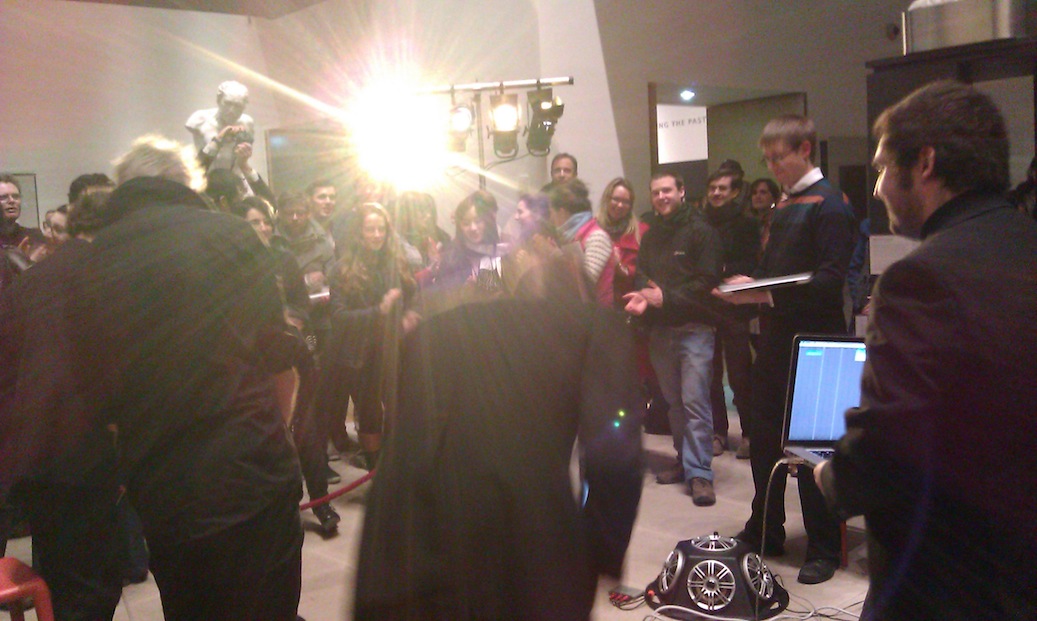
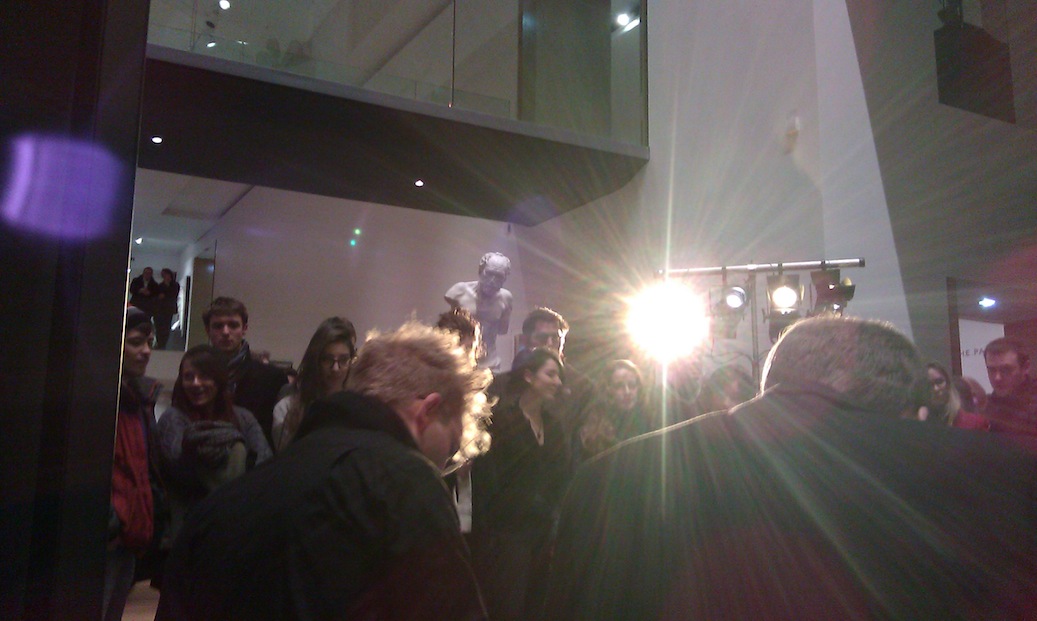
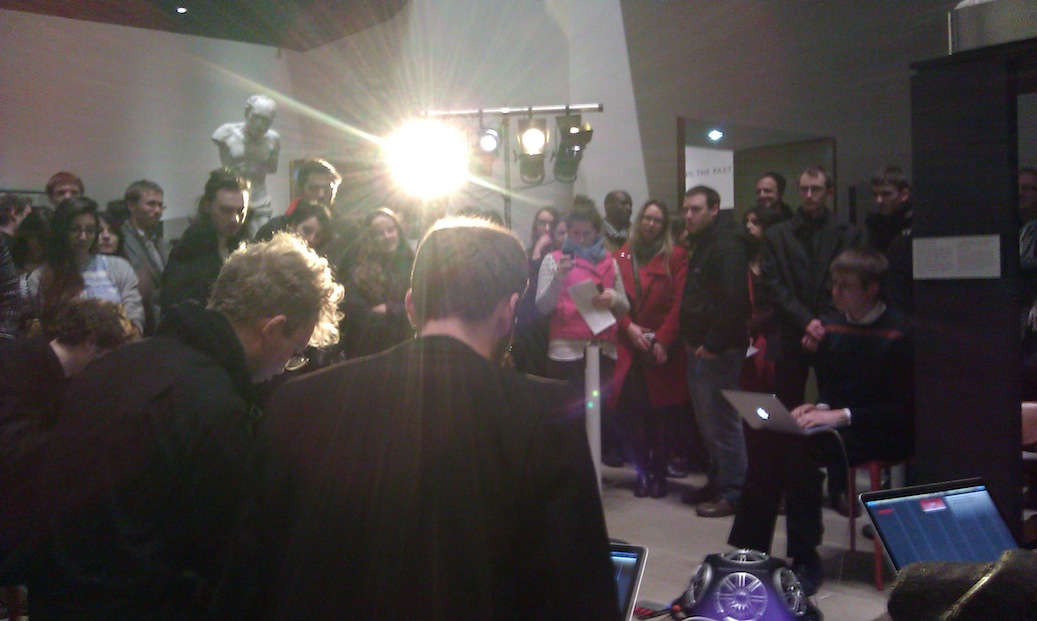
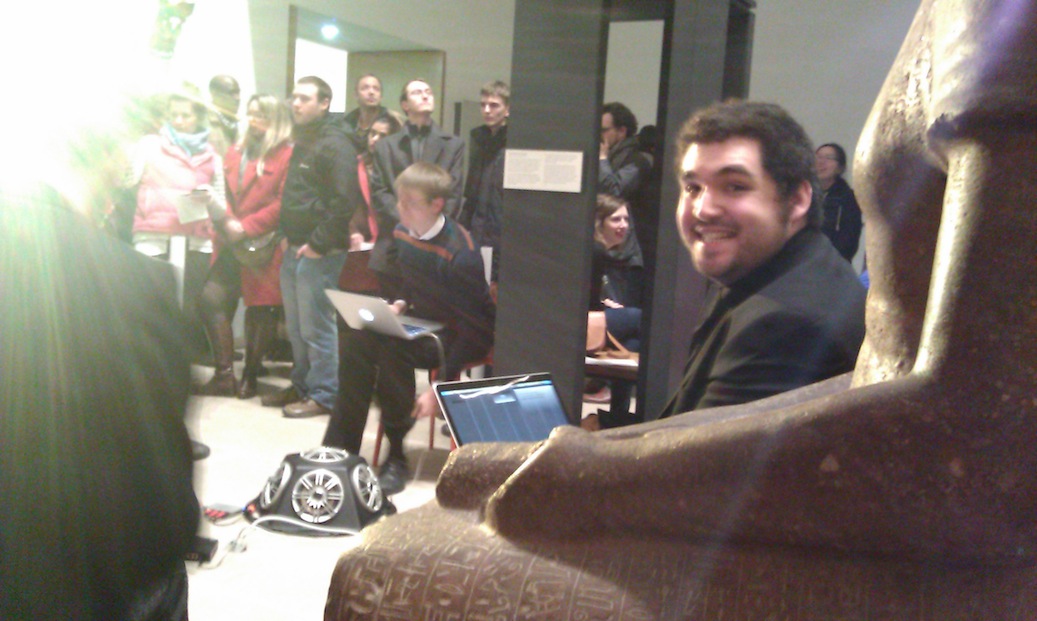
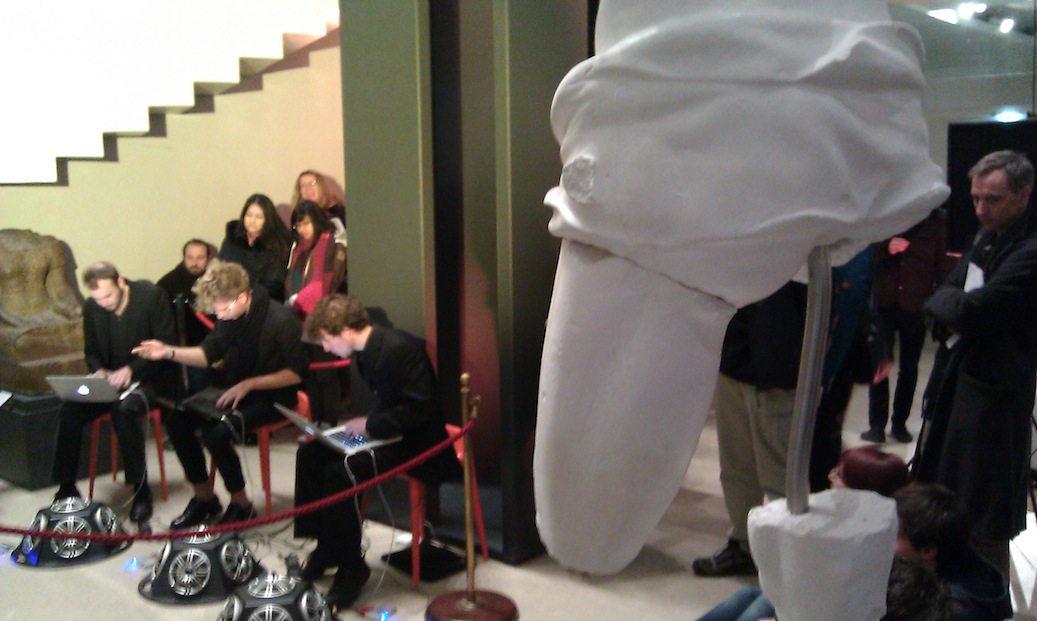
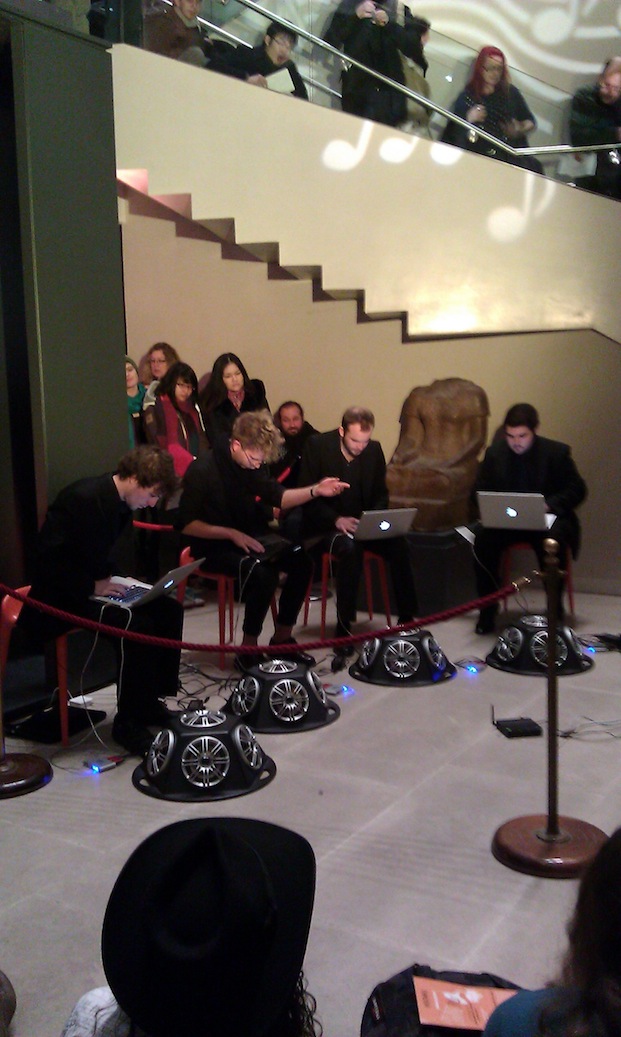
Not brilliant photos, but better than nothing.
Visualising folk tune structures
Traditional tunes have a particular shape to them. Many, especially northern European, have two parts, each repeated, possibly with first and second time bars. Within this arching structure that spans the tune in a few leaps, there are smaller repeated phrases, callbacks and variations. I remembered a visualisation I saw a long time ago which took a MIDI file and visualised the structure. I wanted to do something for the tunes in FolkTuneFinder.
All OxLork code samples online
I am hosting all of the OxLork ChucK lecture code samples here: https://github.com/afandian/oxlork-lecture-code
The trouble with buttons without captions
It seems like everyone’s got their own idea about how to implement a fairly standard commonplace widget. All broadly consistent. With one exception.
Using TASCAM US-122 audio/midi interface with Mountain Lion
(punchline: give up it won’t work but it’s an interesting story)
Oxford Laptop Orchestra – Lecture 4 — Modulation
This is number 4 in my series of lectures in music technology and ChucK to the Oxford Laptop Orchestra. Delivered on the 5th of November 2012 at the Faculty of Music. Give the first three a read before reading this.
The content is complete here (except for a bit about Nyquist) so feel free to read this. But I intend to do a bit of copy-editing, and include sound samples before I declare it complete.
This week we look at low frequency oscillators, using them to modulate other oscillators and in the process how to do more than thing at once._
Oxford Laptop Orchestra — Lecture 3 — Transcending Analogue
This is number 3 in my series of lectures in music technology and ChucK to the Oxford Laptop Orchestra. Read the other two first. Sorry this blog post was a couple of weeks late. It’s quite substantial, but conceptually it underpins a lot of material. Persevere, read, ask questions.
This week sees a bit of a philosophical turn as we contemplate what ‘digital’ really means and how we can use it to play Bach on organ without having to build one first.
Oxford Laptop Orchestra – Lecture 2 – Control Structures and Timbres
This is number 2 in my series of lectures in music technology and ChucK to the Oxford Laptop Orchestra. Give the first lecture a read before reading this.
Last week we took a look at why, in my opinion, music and programming are natural bedfellows. We talked about what a program actually is and how it relates to Western music notation. We compared structural features of music and computer programs. We pinned down what the words ‘analogue’ and ‘digital’ actually mean, how sound is transmitted, and finally we wrote a program that plays a tune.
This week we’re going to continue down two parallel paths: more about the programming language and the nature of sound in general. The reason for all of this is to give you the tools to think about what you hear, apply analytical thought to the process of composition and creation, and to enable you to conceive of and make your own ChucK sounds.