A Meditation on Harmonium Reeds
Buy land, they’re not making it anymore
– Mark Twain
If Mark Twain did indeed say this, it would have been at height of the American pump organ boom. Reeds were being made, and were not in short supply.
Not so today. All the reeds I will ever encounter were made long before I was. They are a finite and diminishing resource.
It’s not strictly true that no-one is making them. There’s a company in Czechia making reeds for all kinds of instruments, including harmoniums. And plenty of Indian harmoniums are being made. These are closely related: as I understand it, when demand dried up in Europe, the German reed makers started selling to India. Locals copied and adapted them. Indian reeds can be found on eBay, but they are designed for the Indian harmonium, which has a different voicing and timbre to the American pump organ.
(If you start with Part 1, I won’t need to re-explain that I use the words ‘harmonium’ and ‘pump organ’ interchangeably.)
There’s no demand for new pump organ reeds because there’s no demand for new pump organs. I find this sad, I think they are brilliant instruments.
Heavy Lifting

Last summer we spent a glorious week visiting friends in Sweden. We stayed in their holiday cabin, spent the days swimming in the lake and the evenings playing Swedish tunes. There was a substantial old organ in attendance, and it was about as cozy as you can imagine.
The word ‘substantial’ is doing some heavy lifting. It would take a couple of people to move that organ anywhere, and they would both need to be in agreement. The music came to the organ, not the other way round. We can’t spend all of our time in lakeside cabins. When sadly we return home to our houses and close neighbours, there isn’t much space. So we go and play tunes in the pub, with whatever instruments we can get on our bikes.
A fold-up harmonium is far more likely to be played.
Knackers
There’s a man in Derbyshire who breaks up old pump organs. He sells the parts on eBay. I buy the reeds, but I find it tragic.
These venerable instruments, once the centre of communal music, are silenced. And future generations of people are deprived of their music.
The reeds are the heart of the harmonium. Not only do they create the sound, but their design and variations make the largest contribution to the timbre of the sound. If there is one part worth saving, it’s the reeds.
I bought the first set because I was convinced that I wouldn’t ever find a replacement for my Bilhorn, and wanted to take the first tentative steps toward building my own. I bought the second set becuase I might need spares. I won’t say how many sets I now have tucked away, but it’s unlikely I will make that many instruments unless I completely change career and run off to make musical instruments. I do know at least five people who have done this; it’s not so far fetched. But I don’t think I have it in me to make bagpipes.
I feel sad, but not guilty. If I didn’t buy them, someone else would. And if they didn’t, he’d probably keep doing it.
The knackers yard may be the point of no return for these instruments, but it’s a rebirth for the reeds. They can be built back into a smaller instrument, more suitable for our times. It may be absurdly profligate to discard carefully engineered machines, only to rebuild them.
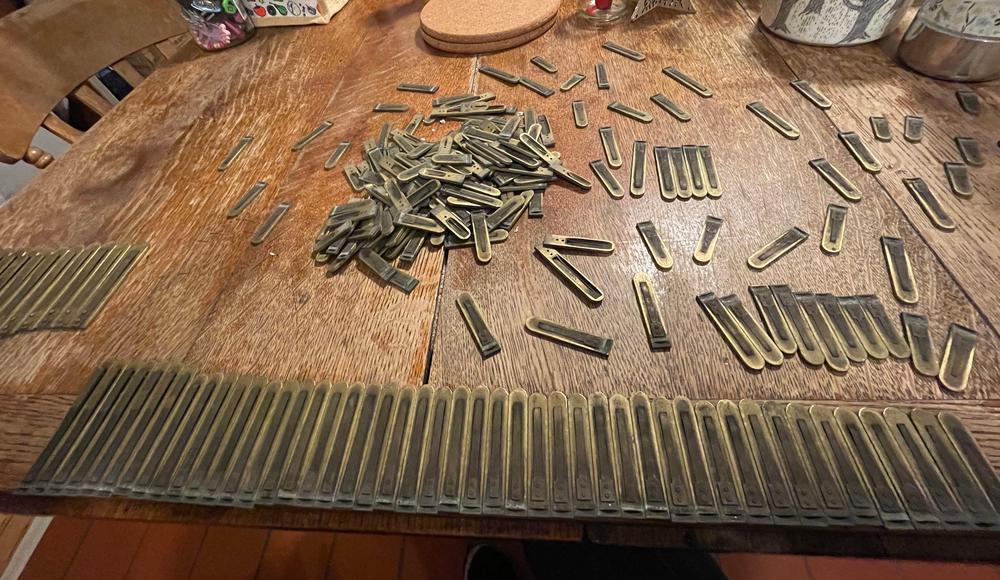
These old organs did get a bit ridiculous in their time. Once they crossed the rubicon, growing from instruments into furniture, complete with cupboards, fake organ pipes, sometimes even mirrors installed, they became bourgeois and inflexibly anchored in their time. If they’d stuck to making portable fold-up instruments the world would be a very different place.
So I can rationalise the process of breaking down and re-building as sad and wasteful, but fine. And there’s plenty of cognitive dissonance to go round.
A meditation
There’s a useful meditation called body scan in which you turn your attention to each body part in turn. When you’re stuck in your head it can help you land back in your body. If you have general uncomfortable feelings it can help clarify them and gain insight.
I have a lot of sets of reeds. When they ripped from their carapace they lost their voice. They also lost their identity.
Minute differences in the reed produce different sounds. Tuning and voicing is a delicate process. Each reed is treated individually, before moving onto the next one. By getting to know these reeds in depth can I try to do them justice. And I’m going to get to know them by carefully studying each one.
Every reed set has had a different story, from its construction, to the music that was played on it, to how it was handled. By sitting with the reeds, looking at each one, and observing the qualities and differences between them I hope I not only gained a deeper understanding, but prepared my mind to work them them.
I don’t claim any specialist knowledge. I am learning as I go, and don’t know much. I’m collecting links to resources I learn from. What I can share here is my journey of perception.
Some of them make a difference to the sound. Some do not. All are worth observing. Not only to gain deeper insight into these reeds and how they work, but to attune myself to the differences and so get closer to them.
Here are all the things I observed as I sat with the reeds.
Sound
A reed makes no sound without air flow. It is designed to have air sucked through it. Putting it against your mouth and sucking produces some sound, but nowhere near the true sound. Blowing through the other direction often doesn’t work. I don’t know why. It may be air turbulence, or needing a baffle below the reed, or something else.
The only way to hear the genine sound is to put them in an organ, or on a tuning table.
Speaking
Does the reed speak at all? If there’s dust or hair caught in the gap it might not.
How much pressure does it need to speak? The voicing of the reed determines this.
Does it only speak at high pressure? The reed may be set too high and require re-voicing.
Does it cut out when the pressure is too high? The tip may set be two far down.
When played in an organ, does the pitch bend with pressure? This may be caused by the material, or the treatment it’s had. The brass may have weakened over time, or been compromised by overly aggressive tuning flatward.
Pitch
Each reed has a different pitch. Two reeds with the same pitch may be from different ranks. There may be other differences between them.
How sharp or flat is the tuning? Many organs were tuned sharp of contemporary concert pitch (A=440). My Mason and Hamlin was reliably 60 cents sharp. My Bell organ even sharper.
How much difference in pitch is there across the set? Are they all in tune with each other?
Tone
What is the tone, or timbre? Is it dark and woody, or bright? Is it too bright? Does it sound soft or hash?
Does one reed stand out from the others in the set? That may indicate that it can be re-voiced.
The voicing of the reed, as well as the materials and shape, affects the sonud. The shape of the chambers inside the organ inside also contributes to the timbre.
Ping
If you run your thumb over the reed from throat to tip, you can gently ping it. It makes a small sound, but you know it has the capability to make sound. I do this after each iteration of tuning to check that it still rings before putting it back in the instrument.
I don’t suggest you pluck it by pulling the reed.
Intrinsic Appearance of the Frame
The frame is the body of the reed. It provides a strong rigid structure that is connected to the harmonium. It provides a place to mount the tongue, which sits in a carefully engineered slot of just the right size to fit.
What can we learn about how it was made?
Individual or many to a panel?
Most reeds are in individual frames. These are designed to fit into slots in the wind chest.
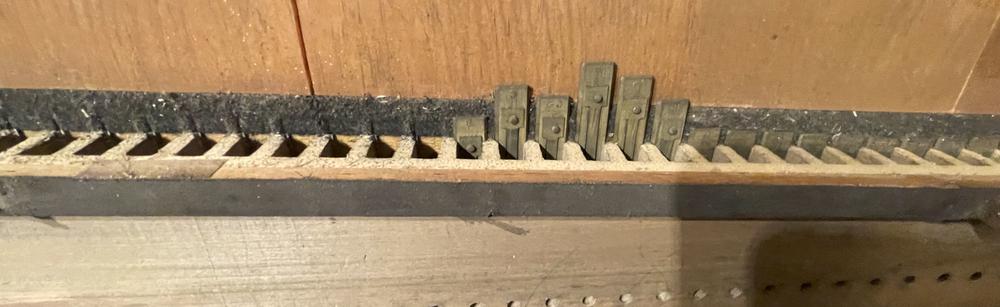
I have one set that came in larger plates though.
Outward shape of the frame
Slide in or screw down?
Round or square?
Closely related
Chamfered or parallel edges?
Width of the frame
does it change going up the scale?
Thickness of the frame
Clearance between the tongue and the frame
Slot shape
Every reed I have seen has a rectangular slot, as viewed from above. But underneath some have a scoop out. This is done to adjust the sound.
Machined
Material
What colour is the brass? Could it be brass or phosphor bronze? Is it the same material as the tongue?
Intrinsic appearance of the tongue
The tongue is the part that vibrates. What can we learn about how it was made?
Complete
Reeds can snap. Is it the original size and shape?
Flat or twisted?
Profile
Weighted?
Is it weighted with a blob of lead?
Is it weighted with brass? How was it attached?
Grinding
Some thicker reeds are ground. This gives them the flexibility, but allows the end to be heavy enough to resonate.
Machining marks
Some reeds have a distinctive stripe. I don’t think this is the result of grinding. It may be from the process of thicknessing.
Ratio of pitch to length
I had a strange experience replacing a reed that I snapped. I found another reed that was a G, and was nearly identical. But it sounded an octave lower. This was perplexing.
How is the reed attached?
It may be attached with a rivet, or screws. There may be one or two of each. They may be different sizes.
They may be ground off to make them flush underneath, or they may not need to be.
Does the rivet have a pattern to it? Does the pattern vary within the set?
Clearance
Rotation
A close cousin of clearnace
might hvae shifted in tuning
two rivets will help
Gap
Material
What colour is the brass? Could it be brass or phosphor bronze? Is it the same material as the frame?
Life experience
Dirt
Corrosion
Past interactions with humans
Has it been tuned?
How has it been tuned?
How many times has it been tuned?
In which direction has it been tuned?
Is it a complete set?
Were all reeds removed? Are any broken? Were some replaced long ago?
Context
Register
Like pipe organs, pump organs can have ‘stops’.
In small organs it is common to have two sets of reeds, one ’normal’ pitch, and one an octave higher. The octave higher is opened and closed with a swell lever, operated by the knee. Then the swell is opened, air can pass through the higher set which adds a lot of brightness to the sound.
Normal pitch is known as “8ft”, after the length of organ pipe of the lowest note in the rank. One octave up is “4ft” and one octave down is “16ft”.
When laying out a set of jumbled up reeds you got through the post you may find duplicates. If you gradually laying these out, lining up the identical pitches, you will find one set starts an octave up from the other set, and extends an octave further.
Compass
Some organs had C as the bottom and top notes. Some organs had F. This was dependent on repertoire and context. Notice the bottom and top notes.
Affordances
The reed was made to be both played and maintained. What was put there for the maintainer?
Slot
When placed in a wind chest the end of the reed pokes out. Often a slot is cut in the end to help you pull them out. But not always.
Marking
Does the reed have a note name stamped on it? Often they do, but not always. Some reeds are so heavily tarnished that you can’t even tell.
Tone system for marking
Most reeds are marked ‘C’, ‘D’, ‘E’. But some are marked with solfeige.
Typeface of the stamp
There is a variety of typefaces.
In a set of reeds you may find one that has a different stamp. Was it from the same factory? Was it replaced later in life?
Orientation of the stamp
What journey has this reed been on?
Gunk
Tarnish
Chemical changes
Conclusion
By this point it is clear that each set of reeds, and each reed within them, is unique.
That was long. But it took no longer than tuning an instrument.